
 Episode 8
More People, More Places, More Often: Behind the Scenes with John Fieldly of Celsius
14 min read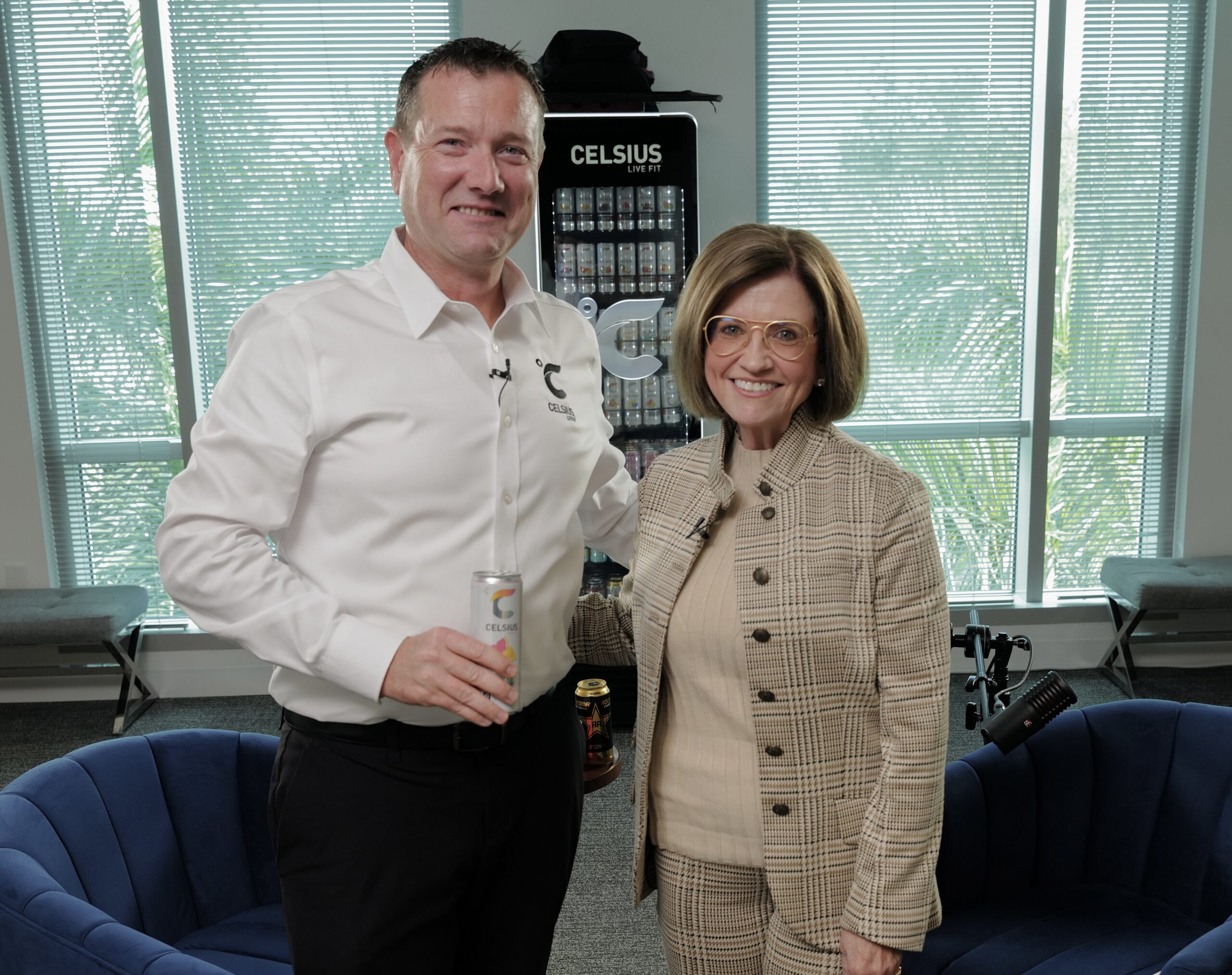
Office Hours: Business Edition · Episode 8 · with John Fieldly, CEO, Celsius Holdings
- John Fieldly has overseen a significant turnaround at Celsius, turning the once-struggling brand into the third most successful company in the energy drink space.
- Fieldly’s success is founded not only on his experience in the retail sector, but also his training as an accountant and tenure as a CPA.
- For Celsius, the reversal in fortunes can be attributed to a better understanding of consumer preferences, summarized in their mantra “more people, more places, more often.”
Listen & Subscribe
By Monica Langley
Celsius has quickly become one of the hottest names in the energy drink space with its brands’ conveying youthful vigor and fun – but you wouldn’t necessarily know it from its corporate headquarters.
I don’t know exactly what I was expecting when I arrived at the company’s Boca Raton location for an interview with John Fieldly, Celsius’ CEO, but it wasn’t what I got: a fairly standard suburban office space, with little of the flash or flamboyance the brand has become known for.
In fact, and with no disrespect toward the company for their enormous hospitality, the conference room where we filmed my “Office Hours: Business Edition” conversation with John was so plain, our production crew had to think on its feet to ensure an engaging, colorful visual. We ended up simply bringing in a large cooler, splashed with Celsius’ vivid branding. It did the trick.
Obtaining that cooler was astonishingly easy. Here’s why: You won’t find a single workspace in the Celsius building – not an office, not a cubicle – that’s more than a few feet away from a well-stocked cooler or fridge. What’s more, in the several hours that I spent on-site, I didn’t observe a single employee without a can of Celsius, Alani or Rockstar – the three major brands in the company’s portfolio – either in-hand or on their desk.
Part of the Ritual
That easy access speaks to John’s broader philosophy, which he encapsulates with a simple shorthand: “more people, more places, more often.” During our conversation, sponsored by UT Haslam, he explained what this phrase means, and how it’s helped take Celsius from a struggling company into a major player in the energy drink space.
Part of Celsius’ success is tied to the growth of the energy drink sector in general, often at the expense of traditional coffee. John told me that, five years ago, it would have been unthinkable for a brand like Celsius to replace the routine of a warm cup of morning joe. But now, even coffee shops report that 70% of their sales are cold drinks. That represents a real opening for the LRB (Liquid Refreshment Beverage) category.
John’s vision is to take full advantage of that opening, finding ways to further incorporate Celsius drinks into consumer lifestyles. Examples include the growing market for energy drinks as alcohol substitutes as well as the diet vertical, where Celsius has successfully established itself as “the better for you” energy drink. While we were chatting off-camera, John even referred to the drink as a “multivitamin in a can” … though of course, your standard multivitamin doesn’t have nearly so much caffeine. When I embarked on a taste test, sampling from a table of several different flavors was more than enough to get me buzzed. Even for a regular coffee drinker like me, the immediate impact of Celsius drinks comes as a surprise.
That gets us back to “more people, more places, more often.” From enjoying a Celsius drink to hydrate after the gym to pairing it with a favorite sandwich at lunchtime, John says the goal is to incorporate these drinks into as many daily scenarios as possible.
“It’s really about expanding those occasions,” he told me. “How do we be part of that ritual?”
Retailers are seeing the opportunity of energy and how much it’s expanding within usage occasion.
Making Converts
One way that Celsius has embedded itself in consumer rituals is by ensuring that every employee is a brand ambassador, always fully stocked with sample products to distribute.
This was something else I saw firsthand while I was on-site with John and his team. If you watch the video edition of our podcast, you’ll see me cruising in one of the company’s branded Jeeps. What you might not realize is that the company has a few of these Jeeps, freshly stockpiled with drinks every single day; Celsius takes these Jeeps to the beach and various events to hand out free beverages to anyone who wants one. The goal, of course, is for that initial sample to create lifelong converts.
This mentality goes well beyond the Jeeps. In fact, every Celsius employee is expected to always have a case of drinks in their home and in their vehicle, ready to pass them out to anyone they come into contact with. While I was at Celsius HQ, I heard John tell employees that, if a FedEx delivery person shows up at their door, they should be handed a Celsius or an Alani. And when employees stop to refuel their vehicle, the expectation is that they offer free drinks to anyone they encounter at the gas station.
These personal touchpoints are part of a broader initiative. Ultimately, John wants to see Celsius taking up more space in convenience stores and other retail venues – another critical way to reach “more people, more places, more often.”
A big part of that is through strategic partnerships, including a distribution deal with Pepsi. “When you think about Pepsi and all their coolers they have around the country, you’re getting the access to those coolers and you’re getting access to those impulse purchases,” John told me.
He also lists hospitals, universities, restaurants and even take-home packs, available from retailers like Amazon, as additional spaces to intersect with consumer lifestyles. “It’s that path of purchase we need to disrupt,” John explained in our interview.
Conveying Confidence
If these sound like the words of a confident CEO, that’s exactly how John came across throughout my time with him. In fact, I was surprised by the level of bullishness he conveyed. Celsius is currently a clear #3 in the energy space, well behind Red Bull and Monster – but according to John, he expects his company to dethrone Monster and become the #2 player in their industry within just a couple of years. Seldom have I heard the CEO of a publicly-traded company throw down the gauntlet so aggressively.
I’ll be watching to see if Celsius can overtake its nearest competitor. Already I’m noticing its brands filling up coolers at convenience stores, recreation spots, clubs and restaurants, getting their drinks into as many hands as possible.
Coda: A few months after my interview with John, his grand plans for Celsius encountered strong headwinds, with a disappointing earnings report leading to restructuring on John’s executive team. It goes to show how quickly this industry can change, and how even the best-laid business plans still require a willingness to pivot.
Resources Mentioned
Term of the episode
Planogram
A planogram is a visual diagram or schematic illustrating exactly where and how products should be placed on retail shelves or displays. Planograms are carefully, strategically considered to maximize product sales.
About the Host

Office Hours are in session with former Wall Street Journal reporter and corporate executive Monica Langley. In this leadership podcast, Langley sits down for unfiltered conversations with the sharpest minds in business – CEOs, founders, and innovators – at the intersection of today’s top business trends and current events. These executive interviews reveal defining moments and hard-won lessons that have shaped their way to the top. Langley brings relentless curiosity into intimate conversations in this business podcast that are only possible because of her tenure as a trusted confidant to and chronicler of leaders of the world’s largest companies. Discover full episodes at haslam.utk.edu/office-hours.